Aadhaar-Enabled DISE Data Capture: Analytics and Student Dropout Tracking in India
📋 Table of Contents (click to collapse)
- Introduction to Aadhaar-Enabled DISE (U-DISE+) System
- The Role of Aadhaar (DISE Number) in Student Identity Verification
- UDISE+ Data Capture Format (DCF): Essential Sections Explained
- How Aadhaar Integration Prevents School Dropouts in India
- Understanding SA2 and SA3 Data Fields in Educational Analytics
- Administration of UDISE+ in Union Territories (Case Study: Dadra & Nagar Haveli)
- Frequently Asked Questions (FAQs)
Introduction to Aadhaar-Enabled DISE (U-DISE+) System
The digitalization of educational metrics in India has undergone a major shift with the introduction of the aadhaar enabled dise system, widely known as U-DISE+ (Unified District Information System for Education Plus). Before this system, the Ministry of Education relied on paper-based DISE forms compiled once a year. This traditional process made it difficult to verify the authenticity of student enrollment figures. The new system integrates a verified student identity verification framework, transforming the database from a simple school count directory into an interactive, real-time student tracking index.
By shifting to an online, identity-linked database, the central government has resolved several chronic issues in educational reporting. The integration of a student's Aadhaar profile directly with their school records creates a single, clean tracking timeline. This setup ensures that every student registered on the database is a real student studying in a recognized school. It eliminates the problem of "ghost students" (duplicate profiles registered across multiple schools to inflate enrollment figures and claim extra funding), ensuring that public resources go to the schools that actually need them.
Managing this system requires school administrators and class teachers to be highly diligent. Every academic year, schools must fill out the detailed udise plus data capture format (DCF). This database contains dozens of sub-forms covering school profile details, infrastructure facilities, teacher profiles, and individual student dossiers. Understanding this system is essential to ensuring that your school remains compliant and qualifies for government infrastructure grants and student benefits.
The Role of Aadhaar (DISE Number) in Student Identity Verification
The core of the digitized educational registry is the linking of the student's Aadhaar card to their aadhar dise number profile. When a school administrator inputs student data into the Student Database Management System (SDMS) module, the system validates the details against the Unique Identification Authority of India (UIDAI) server in real-time. This validation ensures that the student's name, gender, and date of birth match their official identity card exactly.
This verification process serves several critical purposes:
- Deduplication: The database instantly flags duplicate entries. If a student tries to register in two schools simultaneously (e.g., a government school to receive free textbooks and a private school for classes), the system blocks the second entry.
- Welfare Distribution: The government links student benefits, such as pre-matric scholarships, bicycle grants, and school uniform allowances, directly to the Aadhaar-seeded student database, routing payments straight to verified bank accounts.
- Transition Tracking: When a student moves from one block or state to another, their verified Aadhaar profile allows the system to transfer their complete academic record, preventing learning history from being lost during transitions.
UDISE+ Data Capture Format (DCF): Essential Sections Explained
To record this data, school coordinators must fill out the comprehensive u dise form every year. The Department of School Education periodically updates this document to capture new infrastructure parameters and social category details. While many administrators fill out the forms directly online, downloading the offline u dise form pdf beforehand is highly recommended. It serves as a checklist to compile your school records before logging in.
The Data Capture Format divides into several critical sections, each targeting a specific area of school administration:
- Section 1: School Profile & Location: This section verifies the school's basic details, including its UDISE code, geographical location coordinates, management type (e.g., government, private, aided), and medium of instruction.
- Section 2: Physical Facilities & Equipment: This module records the number of classrooms, laboratory facilities, computer terminals, internet connectivity, and WASH (Water, Sanitation, and Hygiene) facilities. Mismatched toilet reports here will flag the school during grant reviews.
- Section 3: Teaching & Non-Teaching Staff: This section profiles every teacher, listing their qualifications, service tenure, subjects taught, and their unique Teacher PEN (Permanent Education Number).
- Section 4: Student Enrollment & Incentives: The largest module in the DCF. It tracks student enrollment class-wise, divided by gender, social category (SC/ST/OBC), religion, and learning disabilities (CWSN). It also tracks the distribution of free textbooks and uniforms.
How Aadhaar Integration Prevents School Dropouts in India
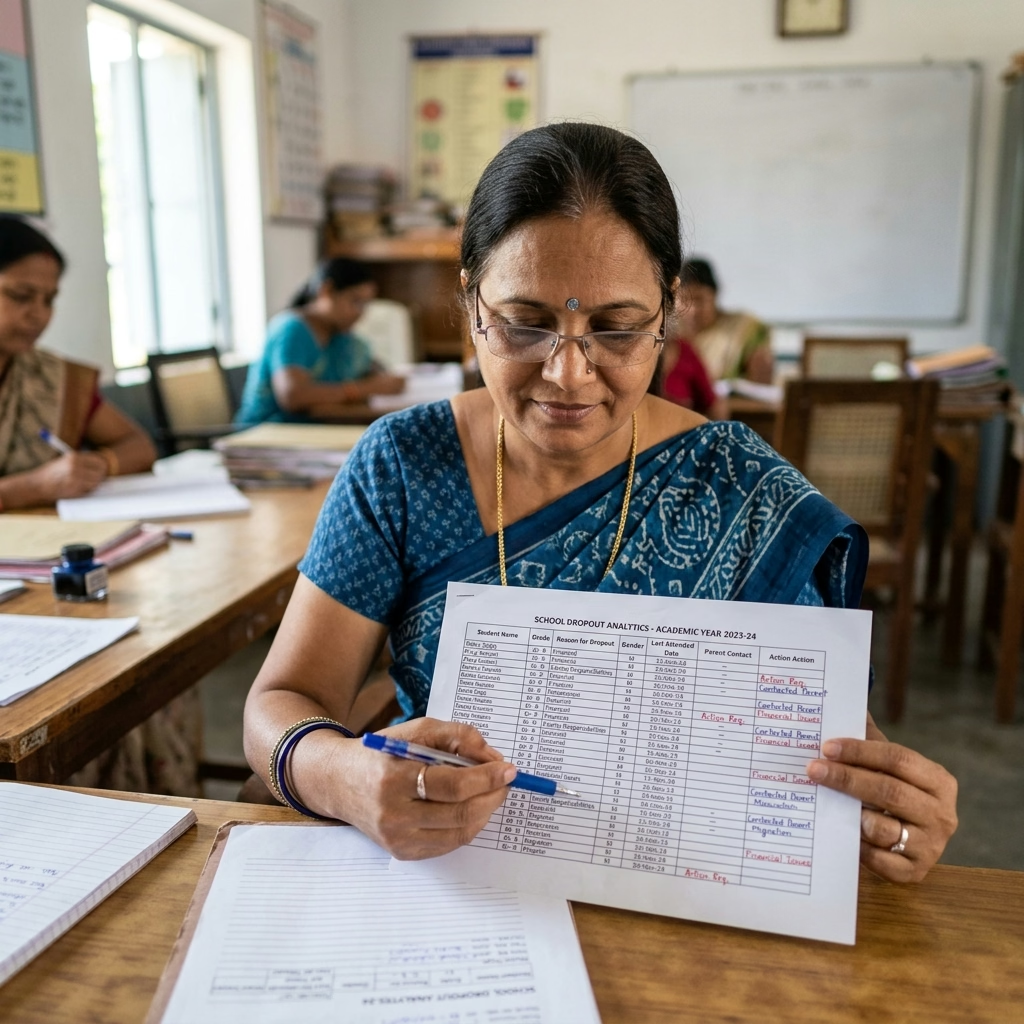
Addressing the high rate of school dropout in india remains a major challenge for the Ministry of Education. Historically, many students dropped out of the school system unnoticed, especially when transitioning from primary to upper-primary or secondary levels. Without individual student tracking, education coordinators could not verify if a student leaving one school had enrolled elsewhere or dropped out of the education system entirely.
The Aadhaar-enabled DISE system resolves this tracking issue. When a student leaves a school, the headmaster must log in to the SDMS and issue an online transfer certificate (TC). This action moves the student's profile to the digital "Drop Box." If the student enrolls in another school, the new school imports their profile from this Drop Box using their unique Student National ID. If a student's profile remains in the Drop Box for more than three months, the system alerts local block education officers, who can intervene and help the student return to school.
This tracking system has significantly improved how India manages school dropouts:
- Precise Attrition Mapping: The system identifies exactly which grades (often Class 5 and Class 8) experience the highest dropout rates, helping the government target its retention campaigns.
- District-Level Intervention: Block MIS coordinators can generate lists of inactive student profiles, enabling local authorities to conduct targeted campaigns in high-risk zones.
- Support for Migrant Students: By keeping academic histories linked to verified Aadhaar IDs, children of migrant workers can resume their classes in new districts without having to restart their academic year.
| Student Status | Database Action | System Tracking Outcome |
|---|---|---|
| Active Enrollment | Aadhaar verified and class promotion certified | Student receives benefits; academic history remains active |
| School Transfer | School marks student as "Transferred Out" to Drop Box | Profile is placed in the national Drop Box, awaiting import |
| Dropout Alert | Profile remains in Drop Box for over 90 days | Triggers a local tracking alert for Block Education Officers |
| Re-admission | New school imports profile using National ID | Restores the student to active status, preserving their learning record |
Understanding SA2 and SA3 Data Fields in Educational Analytics
For detailed data analysis, the Ministry of Education employs specific analytical codes. Among these, the sa2 sa3 data fields are critical for assessing school-level performance and tracking dropout risks. These codes refer to the Student Assessment modules in the database, which measure academic health alongside basic demographic details.
The **SA2** data fields record class-wise student assessment results from the previous academic year. This includes the number of students who appeared for exams, the percentage of students passing, and the distribution of marks across different grades. Analyzing SA2 profiles allows the government to evaluate the quality of education in specific districts, identifying areas that require additional teaching resources.
The **SA3** data fields focus on attendance metrics and student social categories. It tracks how regular students are in their classes and maps dropouts against social indicators like SC/ST enrollment or economic disadvantage. By comparing SA2 (academic performance) and SA3 (attendance and demographic markers) data, researchers can identify early warning signs of student dropout, enabling schools to support at-risk students before they leave the education system.
Administration of UDISE+ in Union Territories (Case Study: Dadra & Nagar Haveli)
Implementing the UDISE+ database in Union Territories requires close coordination due to their unique administrative setups. A great example of this is the work done by the dadra and nagar haveli administrator. This administration has successfully integrated local school systems with the national Aadhaar-enabled database, achieving high rates of student profile completion and Aadhaar validation.
The Dadra and Nagar Haveli administration has tailored the national framework to suit its local needs:
- Block-Level Management: The territory divides its educational management into specific blocks, such as Dadra block (identified by geographic block code 534416). Assigning clear codes helps coordinators monitor data entry progress down to the village level.
- Mobile Verification Camps: To resolve Aadhaar link errors in remote tribal blocks, the administration organized mobile UIDAI camps at schools. This initiative helped parents update their child's Aadhaar details on-site, resolving names mismatches that blocked profile registration.
- Bilingual Support: Recognizing the linguistic diversity of the territory, the administration provided bilingual u dise form pdf guides in both Gujarati and Hindi, helping local school staffs fill out the complex forms accurately.
Udise Plus Student (SDMS) Login Module (State Wise)
❓ Frequently Asked Questions (FAQs)
Here are the most common questions people ask about Aadhaar-Enabled DISE Data Capture: Analytics and Student Dropout Tracking in India.
✅ Conclusion
The transition to an Aadhaar-enabled DISE data capture system marks a turning point in Indian educational administration. By linking student profiles to verified identities, the Ministry of Education has built a transparent framework to measure and reduce school dropouts across India. While the data capture format requires meticulous attention to details like SA2 and SA3 forms, the long-term benefits in policy design and grant allocations are immense. School leaders, district coordinators, and administrators must continue working together to ensure complete, error-free database submissions.