Jawahar Navodaya Vidyalaya Admission and Selection Guide: Complete Reference
📋 Table of Contents (click to collapse)
- Overview of Jawahar Navodaya Vidyalayas and Selection Process
- Historical Trends: Admission Forms, Exam Dates, and Answer Keys
- Prominent Educational Alternatives: TS Model School and Kendriya Vidyalaya Puducherry
- State-Wise JNV Directory: North, East, and Central India
- Southern and Western Directories: Telangana and West Bengal Mapped
- Step-by-Step Guide to Applying for Navodaya Vidyalaya Admission
- Frequently Asked Questions (FAQs)
Overview of Jawahar Navodaya Vidyalayas and Selection Process
Jawahar Navodaya Vidyalayas (JNVs) represent a unique and highly successful initiative in the Indian educational landscape. Established under the National Policy on Education 1986, these co-educational residential schools aim to identify and nurture talented children from rural areas, providing them with quality education equivalent to the best residential school systems. Managed by the Navodaya Vidyalaya Samiti (NVS), an autonomous body under the Ministry of Education, JNVs operate in almost every district across India, spanning 28 states and 8 Union Territories.
Admission to these schools is highly competitive and is determined through a nationwide competitive exam known as the Jawahar Navodaya Vidyalaya Selection Test (JNVST). Designed and conducted by the Central Board of Secondary Education (CBSE), the test evaluates candidates in three main areas: Mental Ability, Arithmetic, and Language skills. The test is non-verbal and class-neutral, ensuring that talented children from rural backgrounds can compete on equal terms without requiring expensive coaching classes or external tutoring.
Because these schools offer free education, boarding, lodging, and uniform facilities, hundreds of thousands of candidates apply for the limited seats available in each district (usually 80 seats per school). For parents, understanding the timelines, patterns, and regional structures of these schools is the first step toward securing their child's future. In this guide, we will analyze historical admission details, compare competitive options, and provide a state-wise breakdown of these institutions.
- Affiliation: All Jawahar Navodaya Vidyalayas are affiliated with the Central Board of Secondary Education (CBSE).
- Medium of Instruction: Instruction is in the mother tongue or regional language up to Class 8, after which it transitions to English for Science and Mathematics, and Hindi for Social Sciences.
- Migration Scheme: Under a unique national integration initiative, 30% of students from one JNV in a Hindi-speaking district migrate to another JNV in a non-Hindi-speaking district for Class 9.
Historical Trends: Admission Forms, Exam Dates, and Answer Keys
Analyzing past trends helps us understand the structure of the Navodaya admission cycle. For instance, studying the patterns of the nvs class 6 admission form 2023-24 shows that the application window typically opens in the late autumn months of the preceding year. During this cycle, candidates had to upload detailed certificates signed by their school headmaster confirming their enrollment in Class 5 in government or recognized schools within the same district.
The examination schedule follows a split or single-phase approach depending on geographical conditions. For example, looking back at the navodaya exam date 2022-2023 class 6 schedule, the test for most states took place in April, while winter-bound districts in hilly regions had their exams in June or September. The CBSE designs multiple sets of question papers to maintain test security, and the evaluation process uses optical mark recognition (OMR) sheets to ensure absolute transparency.
Once the examination concludes, the publication of answer keys is a critical step in the selection timeline. The release of the official navodaya vidyalaya samiti answer key 2022 enabled parents and teachers to verify correct options and calculate potential scores. If there are any discrepancies in the answer key, stakeholders can submit representations to CBSE before the final results are processed. The final selection lists are then published on the NVS portal, and sent to district collectors, district education officers, and school notice boards.
Prominent Educational Alternatives: TS Model School and Kendriya Vidyalaya Puducherry
While Navodaya schools are the primary choice for rural students, several other state and central government initiatives offer similar high-quality education. For parents and students seeking quality boarding or day-school models, checking regional alternatives can open up additional pathways.
In southern India, particularly in Telangana, the Model School program is highly popular. The ts model school admission 2023-24 cycle saw massive participation from rural students. Model schools in Telangana offer English-medium education from Class 6 to Intermediate level, focusing heavily on children from educationally backward blocks. Unlike JNVs, which are fully residential, model schools operate as day schools with excellent laboratory, digital classroom, and sports infrastructure, acting as a great alternative for parents who do not want to send their children to residential hostels at an early age.
For children of central government employees, defense personnel, and floating urban populations, Kendriya Vidyalayas (KVs) provide a standard curriculum. In Union Territories, schools like kendriya vidyalaya puducherry represent the pinnacle of academic excellence. KVs operate as day schools under the Ministry of Education, using a uniform bilingual curriculum (Hindi and English) across the nation. This ensures that children of transferred government employees can resume their studies in a new state without any curriculum gaps. Comparing these structures helps parents make informed choices based on residential preferences and family requirements.
| School Category | Managing Body | Residential Status | Target Population |
|---|---|---|---|
| Jawahar Navodaya Vidyalaya | Navodaya Vidyalaya Samiti (NVS) | Fully Residential | Talented Rural Children (75% seats reserved) |
| TS Model School | Telangana State Government | Day School | Students in Educationally Backward Blocks |
| Kendriya Vidyalaya | Kendriya Vidyalaya Sangathan (KVS) | Day School | Central Government & Transferable Employees |
State-Wise JNV Directory: North, East, and Central India
The distribution of Navodaya schools is organized into regions for administrative convenience. Let us explore the school directories and regions across North, East, and Central India.
In northern India, the hilly districts feature highly active JNV centers. The network of the jawahar navodaya vidyalaya in uttarakhand spans 13 districts, including centers in Nainital, Almora, Chamoli, and Pithoragarh. Due to the high altitude and winter snows, many of these schools operate on a winter-bound academic cycle. This means their term dates and JNVST exam dates differ from the plains to ensure that students do not have to travel during extreme weather conditions.
In northeastern India, the presence of the jawahar navodaya vidyalaya in assam provides critical educational support to rural and tribal students. Spread across 27+ districts, including Barpeta, Cachar, Kamrup, and Jorhat, the Assam JNVs have consistently produced excellent board results. These schools play a crucial role in bringing quality English and science education to remote regions along the Brahmaputra valley.
In the northern border region, the navodaya vidyalaya jammu coordinates educational activities across the Jammu region. These schools operate under the Chandigarh regional office, which manages institutional standards, staff recruitment, and infrastructure grants. In central India, the navodaya vidyalaya chhattisgarh network includes schools in tribal-dominated districts like Bastar, Dantewada, and Surguja. Chhattisgarh JNVs have been instrumental in providing safe, modern residential spaces where students can focus on national-level competitive exams like JEE and NEET.
To coordinate these far-flung schools, the NVS uses regional offices. For example, the navodaya vidyalaya samiti chandigarh region is one of the most prominent administrative zones. It manages JNVs across Punjab, Himachal Pradesh, Jammu & Kashmir, Ladakh, and Chandigarh. The regional office handles student transfers, coordinates JNVST center allocations, and ensures that infrastructure developments meet central guidelines.
Southern and Western Directories: Telangana and West Bengal Mapped
Linguistic diversity is a core feature of the Navodaya system. Let us look at how the schools are distributed in the southern and western regions of India.
In southern India, the navodaya schools in telangana list covers all major districts, including Adilabad, Medak, Nalgonda, Warangal, and Rangareddy. These schools are managed under the Hyderabad regional office. The migration scheme links these schools with Hindi-speaking states, allowing Telugu-speaking students to spend Class 9 in northern JNVs. This exchange helps students develop high bilingual proficiency and build cross-cultural friendships, advancing national integration.
In western India and the Bengal delta, the navodaya vidyalaya in west bengal list includes schools in districts like Darjeeling, Jalpaiguri, Hooghly, Cooch Behar, and South 24 Parganas. West Bengal JNVs operate under the Patna regional office. They are highly sought after by students in rural agricultural tracts. Because competition is intense, parents must begin tracking the NVS portal early to ensure that their local block certifications are complete before the CBSE closes the online application portal.
Step-by-Step Guide to Applying for Navodaya Vidyalaya Admission
Applying for admission to Jawahar Navodaya Vidyalayas requires careful administrative preparation. Because the selection test (JNVST) is highly competitive, submitting an incomplete application or making a mistake in the certificate will result in immediate disqualification. Follow this step-by-step guide to complete the application process correctly:
- Check Eligibility Criteria: Ensure the candidate is studying in Class 5 during the current academic year in a government or recognized school. The candidate must not have appeared for the JNVST in previous years.
- Download the Certificate Template: Visit the official portal (navodaya.gov.in) and download the JNVST admission certificate template. This document requires details such as name, DOB, school name, and rural/urban category.
- Get Headmaster Attestation: Fill out the downloaded certificate and take it to the headmaster of the school where the candidate is studying in Class 5. The headmaster must verify the details against the school admission register, sign, and seal the certificate.
- Prepare Scanned Documents: Scan the attested certificate, candidate\'s photograph, candidate\'s signature, and parent\'s signature. Ensure all scanned files are in JPEG format and meet the size limits (usually between 10KB and 100KB).
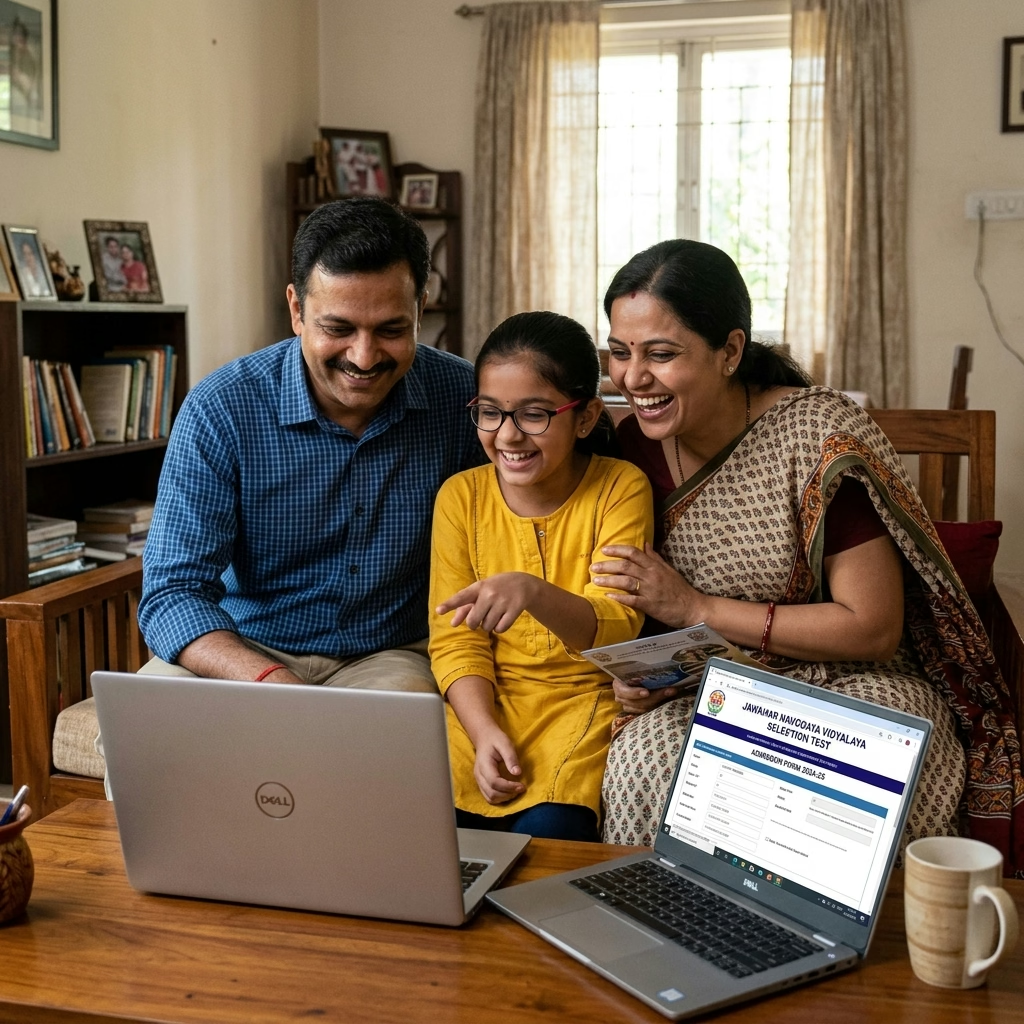
- Complete the Online Form: Go to the NVS admission portal, fill in the candidate\'s personal details, upload the scanned files, and select the exam medium (English, Hindi, or regional languages).
- Submit and Keep a Printout: Verify all entries one final time, submit the application online, and download the confirmation page containing the application number. You will need this number to download the JNVST admit card later.
By following these steps, you can ensure that your child\'s registration goes through smoothly. With dedicated preparation, the JNVST can be the gateway to a world-class education that opens doors to prestigious professional careers across the country.
Udise Plus Student (SDMS) Login Module (State Wise)
❓ Frequently Asked Questions (FAQs)
Here are the most common questions people ask about Jawahar Navodaya Vidyalaya Admission and Selection Guide: Complete Reference.
✅ Conclusion
Securing admission to Jawahar Navodaya Vidyalayas remains a life-changing milestone for students in rural India. By analyzing the requirements of the nvs class 6 admission form 2023-24, looking at historical details like the navodaya exam date 2022-2023 class 6 and navodaya vidyalaya samiti answer key 2022, you can better prepare for the coming selection cycles. Whether you are looking for a jawahar navodaya vidyalaya in uttarakhand, a jawahar navodaya vidyalaya in assam, or analyzing schools in jammu, chhattisgarh, or west bengal, early preparation is the key. Keep your state-wise certificates ready, follow the registration guidelines carefully, and check the official NVS portal regularly for the latest updates on examination schedules and seat matrices.